
CDP vs CRM comes down to who uses the data and why. A CRM manages your relationships with known customers and leads, and a CDP unifies data about those same known people so marketing can act on it. Put simply, the CRM is the record of what your team did with a customer, and the CDP is the combined record of everything that customer did with your brand.
Both tools cover people who already know you. Neither answers a question every growth team asks: how do you find and reach new people? That job used to belong to the DMP. Now that cookie-based targeting is weaker than it was, a newer tool handles it: the audience data platform.
This guide defines all four, compares them in one table, and shows which one you need for which job.
What is a CRM?
A CRM (customer relationship management) system is software that stores and manages your company’s relationships with known customers and leads.
A CRM holds:
- Contacts
- Companies
- Deals
- Support tickets
- Emails and call notes
Sales reps use it to work their pipeline. Service teams use it to track cases. Managers use it to forecast revenue.
Most CRM data comes from direct interactions: a rep logs a call, a lead fills out a form, an email syncs from an inbox. That makes the CRM very good at one thing: knowing the history of your relationship with each person or account.
It has limits. A CRM usually doesn’t capture full browsing behavior, combine data from your ecommerce, app and email platforms, or tell you anything about people who aren’t in it yet.
CRM examples: Salesforce Sales Cloud, HubSpot CRM, Microsoft Dynamics 365 Sales, Zoho CRM.
What is a CDP?
A CDP (customer data platform) is software that collects first-party data from every system where customers interact with you and unifies it into one profile per person.
A CDP pulls in:
- Website and app events
- Purchases
- Email engagement
- Support history
- And your CRM records
It matches those records to the same person and produces a single customer view. Marketers then use that profile to build segments, personalize email and onsite experiences, trigger journeys, and send audiences of known customers to ad platforms.
Everything a CDP holds is first-party data: data you collect directly from your own customers and visitors. Many CDPs also store zero-party data, the information customers volunteer, such as preferences or quiz answers.
A CDP resolves identity using identifiers people have shared with you: email address, phone number, login, and device IDs tied to those. Anonymous visitors stay anonymous until they identify themselves, usually by logging in, buying or filling out a form.
CDPs come in two main forms:
- A packaged CDP stores your data in its own system
- A composable CDP keeps your data in your own warehouse, such as Snowflake, BigQuery or Databricks, and adds identity, modeling and activation on top.
For more on that model, see our post on identity resolution for warehouse-native CDPs.
CDP examples: Twilio Segment, Bloomreach, Tealium, and composable options like Hightouch (see our Hightouch alternatives page).
What is a DMP?
A DMP (data management platform) is software that collects and organizes mostly anonymous, cookie-based audience data so advertisers can target segments in programmatic advertising.
In marketing, that is what DMP means. The acronym has other meanings in other fields, so context matters.
A DMP worked like this:
- It set cookies on websites, collected browsing signals, and bought segments from third-party data providers, such as “in-market for an SUV” or “frequent traveler.”
- It then sent those segments to ad-buying platforms to target display and video ads.
- The profiles were tied to anonymous cookies and device IDs, not to people, and they were short-lived.
DMPs relied on third-party data because their job was reach. To advertise to people outside your customer base, you needed data about people you had no relationship with, and third-party cookies were the main way to get it.
That model has weakened. Safari and Firefox block third-party cookies by default. Chrome still supports them after Google dropped its plan to remove them in 2024 and confirmed in 2025 that it would keep its current approach. But consent requirements, tracking prevention and the walled gardens of Meta, Google and Amazon have all reduced how far cookie-based audiences can reach. This shift is what people mean by cookieless advertising.
The market reflects it. Oracle shut down its advertising business, including the BlueKai DMP, on September 30, 2024. Publicis Groupe acquired Lotame in 2025 and folded it into Epsilon.
DMP examples: Adobe Audience Manager, Lotame (now part of Epsilon), Oracle BlueKai (discontinued in 2024).
DMP vs DSP
These two are often confused. A DMP builds and stores audiences. A DSP (demand-side platform) buys ad inventory programmatically by bidding on impressions. The DMP decides who to target. The DSP buys the ads that reach them. Untitled runs its own DSP for connected TV, so audiences built in Untitled can be bought on CTV without moving them to another platform.
What is an audience data platform?
An audience data platform is software that identifies people, groups them into audiences based on who they are and what they are interested in, and sends those audiences to advertising and marketing channels. Unlike a customer data platform, it is not limited to people who have already given you their information.
It does the job the DMP used to do, reaching new people, but with people-based identity instead of anonymous cookies. It also does things a DMP never could, such as identifying your own anonymous website visitors and reaching people through direct mail and streaming TV.
Audience data platform examples: Untitled is an example of an audience data platform. We cover how it works later in this post. See our comparisons like DataMoon alternatives, AudienceLab alternatives, and Zeta Global alternatives.
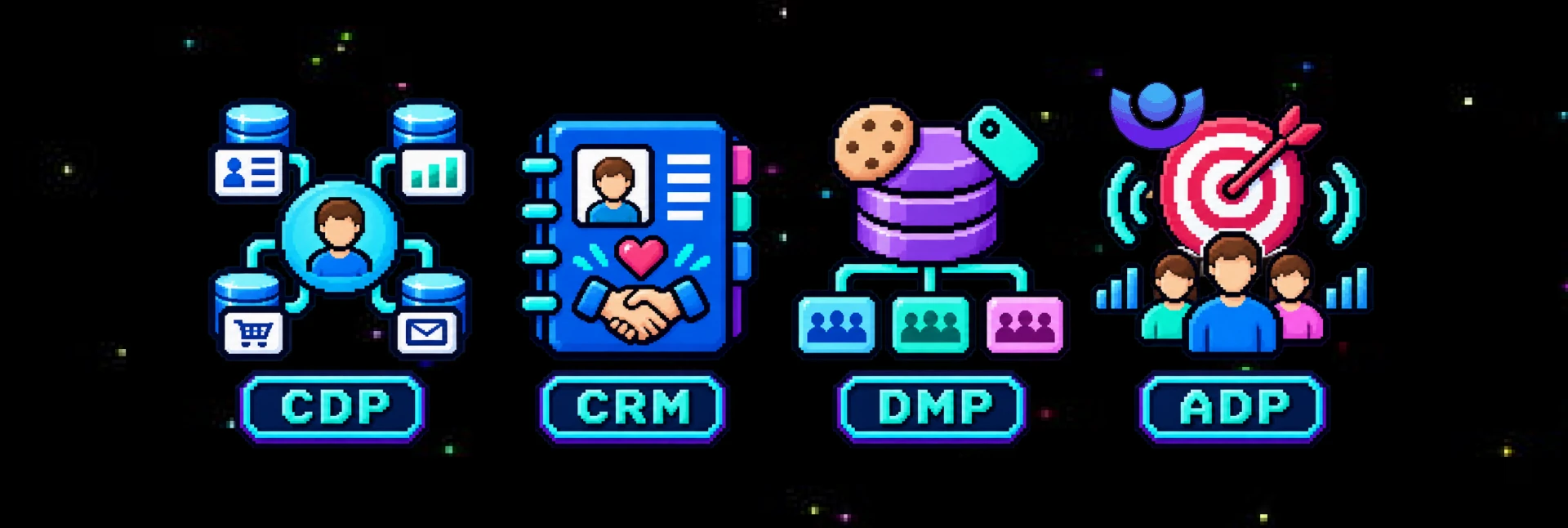
CDP vs CRM vs DMP vs audience data platform comparison table
| CRM | CDP | DMP | Audience data platform | |
|---|---|---|---|---|
| Main job | Manage relationships, pipeline and service for known contacts | Unify first-party data into one profile per customer | Build anonymous audience segments for programmatic ads | Identify people, build audiences from identity and intent, and send them to channels |
| Whose data | Known customers and leads | Known customers, plus anonymous visitors until they identify themselves | Mostly unknown people, seen as anonymous devices | People who don't know you yet, plus your own visitors and customers |
| Identity type | Person or account record | Person profile built from first-party identifiers (email, phone, login) | Anonymous cookie and device IDs | Person-level identity graph anchored on hashed emails |
| Data sources | Sales and service activity, form fills, email and call logs | Website and app events, purchases, email, CRM, support | Third-party cookies, data provider segments, some site data | Identity graph, consumer intent data, visitor identification, enrichment, your CRM or CDP |
| Main users | Sales, service, account management | Marketing, lifecycle and data teams | Media buyers, ad ops, agencies | Performance marketing, growth and media teams, agencies |
| Typical outputs | Contact records, deal pipeline, forecasts | Single customer view, segments, journeys | Audience segments for ad platforms | Prospecting and retargeting audiences, identified visitors, enriched records |
| Activation channels | Sales outreach, email, service | Email, SMS, app, onsite personalization, ads to known customers | Programmatic display and video | Paid social, Google, streaming TV, display, direct mail, email |
| Examples | Salesforce Sales Cloud, HubSpot CRM, Microsoft Dynamics 365 | Twilio Segment, Salesforce Data 360, Adobe Real-Time CDP, Bloomreach | Adobe Audience Manager, Lotame, Oracle BlueKai (discontinued) | Untitled, Zeta Global, AudienceLab, DataMoon |
CDP vs CRM: the main differences
Both tools store data about customers, which is why people mix them up. They differ in five ways.
1. Purpose
A CRM helps your team manage relationships: who to call, which deals are open, which cases need a response. A CDP helps marketing understand and reach customers as a group: who bought twice, who browsed but didn’t buy, who opened an email last week.
2. Data sources
A CRM mostly holds data your team enters or logs from direct contact. A CDP collects data automatically from many systems, including the CRM itself, your website, your app, your ecommerce platform and your email tool.
3. Behavioral data
A CRM records interactions. A CDP records behavior: pages viewed, products added to cart, app sessions. That behavioral data is what makes CDP segments more detailed than CRM lists.
4. Identity
A CRM record is usually created when someone becomes a lead. A CDP can track anonymous visitors and merge their history into a known profile once they identify themselves. Neither one identifies visitors who never share their details.
5. Main users
Sales and service teams live in the CRM. Marketing, analytics and data teams use the CDP.
| CRM | CDP | |
|---|---|---|
| Built for | Sales and service | Marketing and data teams |
| Main question it answers | "What's our relationship with this customer?" | "What does this customer do across our brand?" |
| How data gets in | Manual entry, form fills, email and call sync | Automated collection from site, app, commerce, email and CRM |
| Anonymous visitors | Not tracked | Tracked until they identify themselves |
| Output | Contact and deal records | Unified profiles and segments |
The line between them is blurring. HubSpot has added CDP-like data tools to its CRM, and Salesforce sells Data 360 alongside Sales Cloud. If most of your customer data already lives in one CRM, that may be enough. If it is spread across many systems, a CDP is usually worth adding.
CDP vs DMP: known customers vs anonymous audiences
A CDP and a DMP both build audiences, but for opposite ends of the funnel.
| CDP | DMP | |
|---|---|---|
| Data type | First-party, often including personal details | Mostly third-party and anonymous |
| Identity | Persistent person profiles | Short-lived cookie and device IDs |
| Main use | Retention, personalization, lifecycle marketing | Prospecting and reach in programmatic ads |
| Data retention | Long-term | Short-term, tied to cookie lifespans |
| Status today | Widely adopted and growing | Declining as cookie-based targeting weakens |
As DMPs faded, their work split up. CDPs took over activating first-party data. Data clean rooms took over secure data sharing between partners, such as a brand and a retailer matching customer lists without exchanging raw records. Most CDP vendors stop the story there.
That leaves a gap. A CDP can only reach people already in it. Something still has to find new customers, and cookies alone no longer do that well. That is where the audience data platform comes in.
Where the audience data platform fits
The CRM and CDP manage people who already know you. The DMP tried to find new people with cookies. The audience data platform finds and reaches new people with real identity, helps convert current demand, and works alongside your CRM and CDP.
A customer data platform organizes data on people who already know you. An audience data platform adds the people who do not know you yet and connects both groups to the channels where you advertise. Many teams use both.
Here is how Untitled does that:
A person-level identity graph
Instead of anonymous cookies, Untitled uses an identity graph of more than 300 million U.S. person-level records. Hashed email addresses are the identity anchor, which is also how Meta, Google and other ad platforms match audiences. The process of linking emails, devices, names and postal addresses to the same person is called identity resolution.
Visitor identification
The Untitled ID Tag identifies about 50% of website traffic at the person level, including name, email and postal address, with no form fill. That turns anonymous traffic into people you can retarget or identify and follow up with.
Interest and intent
Untitled builds intent audiences from more than 36,000 intent topics, based on content consumption across more than 300,000 publisher websites and refreshed weekly. It also enriches records with more than 30 data points.
Activation
With integrations in Untitled, audiences sync in one click to Meta, Google, TikTok, Pinterest and LinkedIn Ads, with published match rates of up to 75% on Meta and Google Ads. The native Untitled DSP reaches connected TV on Hulu, Peacock, Prime Video and more than 40 other partners, with no seat fees. Direct mail retargeting postcards go out within 24 to 48 hours of a site visit.
Untitled uses a consent-based framework of first- and second-party data, built on U.S. records only.
If you’re evaluating vendors in this space, you can compare audience data providers side by side.

Which one do you need?
Start with the job you need done.
| If your goal is to... | You need a... |
|---|---|
| Manage a sales pipeline, accounts and service cases | CRM |
| Combine customer data from many systems into one profile | CDP |
| Personalize email, SMS and onsite experiences for existing customers | CDP |
| Reach new buyers who don't know your brand yet | Audience data platform |
| Identify anonymous website visitors and retarget them | Audience data platform |
| Reach prospects through streaming TV or direct mail | Audience data platform |
| Match data with a partner without sharing raw records | Data clean room |
| Buy programmatic ad inventory | DSP |
A few patterns hold for most consumer brands:
- You almost always need a CRM or a customer database. For many DTC brands, the email platform plays this role at first.
- Add a CDP when customer data is spread across ecommerce, email, app, support and in-store systems, and your marketing team needs one view of it.
- Add an audience data platform when growth depends on reaching new people, when most site visitors leave without identifying themselves, or when cookie-based prospecting audiences have stopped performing.
Most teams end up with two or three of these. If acquisition is the gap, Untitled’s target audience platform is built for that job.
How they work together in your MarTech stack
These tools are layers, not rivals. A typical martech stack connects them like this:
- Your CRM and CDP hold your known customers. They are the source of truth for who has bought, subscribed or talked to sales.
- The audience data platform syncs from them. Untitled connects to Klaviyo, HubSpot, Salesforce, Mailchimp, Postgres and Athena as sources, so it knows who your customers already are.
- It builds new audiences around them. You can exclude existing customers from prospecting, target people with matching interests and intent, and identify the anonymous visitors on your site.
- It sends audiences to your channels. Paid social, Google, streaming TV, display and direct mail all draw from the same people-based audiences.
- Results flow back. Newly identified visitors and enriched records are pushed back to your CRM or CDP, so sales and lifecycle teams can act on them.
The result is one loop: known customers inform who you target, and new people you reach become known customers.
Frequently Asked Questions
No. A CRM records and manages relationships with known customers and leads, mostly for sales and service teams. A CDP collects data from every system where customers interact with your brand, including the CRM, and unifies it into one profile per person for marketing. The CRM is your record of team interactions. The CDP combines and activates customer data.
A CDP stores first-party data about people who already know you, such as emails, purchases and site behavior, and keeps those profiles over time. A DMP collected mostly anonymous, cookie-based third-party data to build short-lived audience segments for programmatic ads. CDPs support retention and personalization. DMPs supported reach and acquisition, a model that weakened as browsers limited third-party cookies.
In marketing, DMP stands for data management platform. A DMP is software that collects and organizes audience data, mostly from anonymous cookies and third-party data providers, and sends audience segments to ad-buying platforms for programmatic advertising. Examples include Adobe Audience Manager and Lotame. Outside marketing, DMP has other meanings, so check the context.
Both, through different products. Salesforce Sales Cloud and Service Cloud are CRM products that manage contacts, deals and support cases. Salesforce Data 360, previously called Data Cloud, is Salesforce's customer data platform. It unifies data from Salesforce and outside systems into customer profiles. Many companies use Salesforce's CRM without its CDP.
HubSpot is a CRM first. It stores contacts, companies and deals, and its marketing, sales and service tools are built on that CRM. HubSpot has added CDP-like features, such as data syncing, data quality tools and unified records, through its Data Hub. For teams whose data lives mostly in HubSpot, that may be enough. Teams with many data sources often add a dedicated CDP.
Common CDP examples include Twilio Segment, Salesforce Data 360, Adobe Real-Time CDP, Bloomreach and Tealium. Composable or warehouse-native options, such as Hightouch, build profiles and audiences on top of data you already keep in a warehouse like Snowflake, BigQuery or Databricks. The right choice depends on where your data lives and which channels you need to reach.
Not always. If most of your customer data already lives in your CRM and email platform, the CRM may be enough. A CDP earns its cost when customer data is spread across many systems, such as ecommerce, apps, email, support and point of sale, and marketing needs one combined profile. Neither tool helps you reach people who do not know you yet.
An audience data platform is software that identifies people, groups them into audiences based on who they are and what they are interested in, and sends those audiences to advertising and marketing channels. Unlike a customer data platform, it is not limited to people who have already given you their information. Untitled is an example.
No. Both help you reach people who do not know you yet, but they identify those people differently. A DMP relied on anonymous, short-lived cookies and device IDs. An audience data platform uses people-based identity, such as hashed email addresses linked in a person-level identity graph. It can also identify your own site visitors and reach people through streaming TV and direct mail.
Yes, and many teams do. The CRM manages sales and service relationships. The CDP unifies data about known customers. The audience data platform reads from those systems, excludes or targets existing customers, finds new people who fit your goals, and sends audiences to ad channels. Newly identified visitors then flow back into the CRM or CDP.
About Untitled
Untitled is a consumer-first audience data platform for mid-market and enterprise consumer brands, DTC and eCommerce companies, and performance marketing agencies. It identifies anonymous website visitors as real people, builds audiences from consumer intent data, and activates them across paid social, Google, streaming TV and direct mail. It works alongside your CRM and CDP, not in place of them.
Learn more about Untitled today by booking a demo with our team.